This article originally appeared in The I/O Port Newsletter, a `Computer User-type' magazine of the Tulsa Computing Society (Box 3211, Tulsa, OK 74101-3211) 9/95
Al Gore may not be far off when he claimed that the telecommunications industry will be the foremost export and the world's No. 1 business by the year 2000. Vice-President Gore's perception in `Infrastructure for the Global Village' (Scientific American, Sept. 1991), was:
"When millions of individuals process information simultaneously, the aggregate result is incredibly accurate and efficient decisions." Imagine, the ability of millions of users to connect to the same `Inter'-net(work) at the same time and actually work together.
Need I say more? The Internet--Cyberspace, is here to stay.
So now that it is here, what do we do with it?
As a consultant, companies have asked my opinion on giving their employees access to the Internet in the workplace. It would seem that they have heard rumors of how this access can be abused. They are therefore, somewhat reticent to supply this access. My advice? If it is valuable to the company, give it to your employees. At least give it to the employees you know and trust well enough, who are the self-starters, the dedicated individuals, the trustworthy ones. Still, if this does worry you, perhaps you should also see to it that these employees have Internet access from home. In my experience, it has been the individuals newest to the Internet (particularly the World Wide Web, or WWW), who are the most frequent abusers of corporate Cyberspace privileges. The `old hands,' chiefly the ones linked up from home, tend to do any `playing' from there, too; where it is after all, much `safer' and the freedom of action, more pervasive.
Since anyone can read in any variety of traditional paper magazines, or the newer, on-line electronic `zines', all the things possible in Cyberspace, allow me to just cruise through exactly what it is that I do within it.
This dual behavior of exploration, and/or research, and product gathering is apparently a bane to corporations as it simultaneously serves both corporation and employee. That is, while one searches the Internet--on authorized Company Time, one tends also to find things interesting on a personal level.
Uh, oh: "Danger! Will Robinson!"
The personally interesting Internet sites I find while at work, are the sites that I simply make note of. I save interesting web page locations (URL's) either to the `Hotlist' in Mosaic, the `Bookmark' in Netscape, or I simply jot it down, typically on (oh, no!) `Postit' notes for future reference (though only from home). After all, I AM being paid far too much to be misusing company time. Besides, it's just not worth getting caught when I can do far more and get far more in-depth into whatever I am currently pursuing, while relaxed at home.
Interestingly and ironically enough, while searching Cyberspace on my personal time I even more frequently run across various web sites, web pages, other resources and individuals that could be invaluable, WHILE I AM AT WORK!
The point here is, that while one cannot make use of one's time at work for personal use, one does end up supplementing work with whatever is learned at home. A benefit, I might add, that is at no extra cost to my employer. I have spent many hours at home, searching the Internet for work related information, merely out of habit, before I even realized what I was doing. Needless to say, I don't bother trying to extract pay for this from my employers. However, don't lose heart, this habit CAN make your work (and you) look better in the end. Whatever you learn on the Internet, whatever resources you do happen to uncover, will inevitably turn out to be valuable to you at some point in the future.
You may now, very well be asking yourself, "Okay friend, what ARE some of these web sites, web pages, individuals and other resources that could be so invaluable, and fun?"
Primarily, the Internet gives me access to a huge variety of discourse and to `experts' from whatever field I may require information. Typically, this is by way of the Usenet Newsgroups, or World Wide Web pages. One page can lead to another, and you may find your answers (and yourself) in the strangest of places. There are many people who will be quite happy to be your personal `expert-on-line.' This is especially true on the newsgroups; web pages seem to be set up to some degree, to save the individual time from scouring the Internet themselves. Lets face it, it IS quite flattering to be someone's `expert'; especially, when it is as anonymous and responsibility free as the Internet can be. But please, all you future Cyber-Researchers, do consider validating any information you get off the Internet from at least one or (even better) two other sources, just to be sure.
This does not, however, make your initial `expert' any less valuable. Sometimes your `expert' will steer you into the right direction to begin with, and that in itself can be invaluable.
As an example, I was in an artists' newsgroup back in 1990. Someone asked a question about the composition of a specific artist's oil paint. I believe it was umbra tempura, and they mentioned a specific brand. The most interesting response was from a gentleman working at NASA. He wrote in-depth about its composition, down to the molecular level. He also included a short diatribe on the history of tempuras, their usage by the masters and spoke of the various ingredients used in these paints (artists used to make their own oils by hand). He went on to explain the progress of tempura paints through history, including the typical usage of ground eggshells. In closing, this `expert' from NASA went on to refer to the practice by other masters of grinding down precious gems (as was used in the varnishes of a Stradivarius).
The second thing the Internet allows me to do, is to enrich my view on life. One can learn and experience vast amounts of things (some you may want to know about, some maybe you would not), by simply hopping around the Internet universe (and who will be the first to suddenly realize that they have left the Internet and are now on an alien web surfer's web page?).
This hopping around was something I used to do in the mid-to-late 1980's at the Internet's original text based level. It is now something that I do using my preferred web browser (which happens to be Netscape's 32 bit version browser.
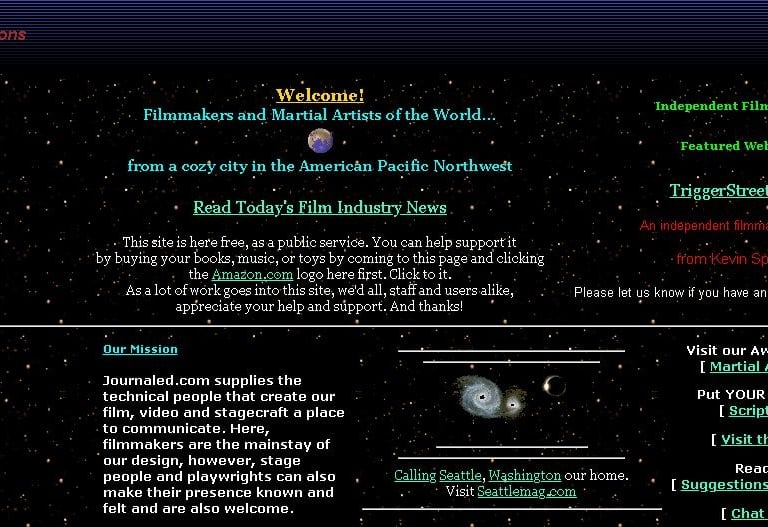
So where does this all lead one? Well, all of this eventually leads one to develop and maintain a Web page of one's own. After all, once others have shared of their knowledge, isn't it only fair that in some small way, this effort is repaid? Besides, part of Cyberspace and the whole Global Village concept is sharing information, giving some of your time to others, and thus finding yourself truly `Networking': functionally, literally, and metaphorically. Don't worry, though. You will simply begin sharing your knowledge without even realizing it, mostly because it is simply pleasurable to do so.
Of course, fully utilizing the Web means you must learn Hyper Text Mark-up Language (HTML), the embedded code that generates Web Pages; to some degree, anyway. Once again, don't worry. Web page writing in HTML comes pretty easily. Just be prepared.
Web pages allow you to put on-line: your views, your hobbies and your interests; pictures of your favorite plant(s), airplane(s), or people; your resume, your friends' resumes; even your philosophies. Web pages allow you to meet others of similar viewpoints that you would never have had access to any other way. As well as the DISSIMILAR ones.
A brief warning: Be aware of a thing called `Nettiquette'. The best advice is to acquire a working knowledge of this set of on-line rules of social ettiquette. Most forms of ettiquette exist to help individuals in a social group interact regardless of their differences, so that the group can share in the benefit of the interactions.
Ignoring this `Nettiquette', can lead one to some very annoying problems in Cyberspace. Problems such as "Flames": negative email or public postings. Flames can lead to, in its most negative sense, an overabundance of email. Very simply put, be nice online. Be understanding. And, first and foremost, don't waste people's time, especially through ignorance. It's a case of a little time spent learning the ropes can go a long way. `Nettiquette' FAQs (Frequently Asked Questions documents), are freely available in a variety of Internet locations and can quickly solve the ignorance dilemmas.
Owning and sharing web pages with the world can help you to quickly learn the ropes, as well as sharpen your original views on any variety of subjects, to crystal clarity. All this, without leaving your own web page. It is a way to enrichen your views, your beliefs, your personality, and possibly your career-- with little or no effort at all.
And finally, it can just be fun.